
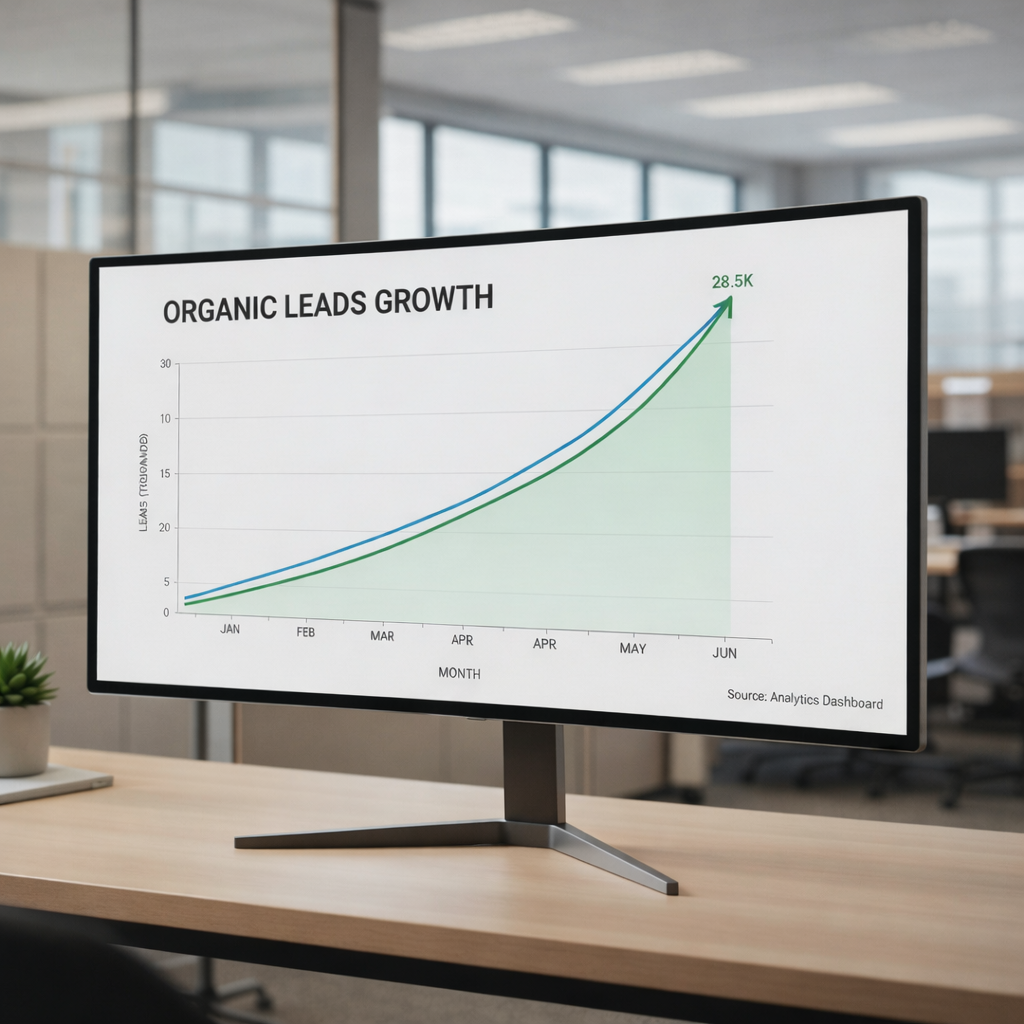
What if you could create consistent leads without spending a lot on ads?
Organic leads will become the most valuable asset in 2026, as online attention becomes harder to capture, ad costs surge, and competition rises across every industry. In 2026, it will be more difficult than ever to gain attention online. Advertisements are pricey. Competition is rising. Customers have more options and less patience. So, how do smart firms expand without investing heavily in paid campaigns? The solution is simple: organic lead generation. Organic leads do not arise from interruption. They stem from intention. People search, discover you, trust you, and then contact you. And SEO is what makes this possible.
What Is Organic Lead Generation?
Organic lead generation refers to attracting new clients through search engines without paying for advertisements. Organic traffic is when someone searches Google and then hits your website. When a visitor submits a form, phones your team, or writes an inquiry, they become an organic lead. Unlike commercials, which disappear when the budget is depleted, SEO creates long-term visibility. It establishes a technique that consistently attracts the correct audience to your business.
Why SEO Matters More Than Ever in 2026?
Most purchasing choices still begin with a search. If your company appears when customers are actively looking, you will get folks who are already interested. This means higher conversion rates and greater confidence.
Good SEO helps you:
- Rank higher in search results
- Build authority in your industry
- Reduce dependency on paid ads
- Generate consistent organic leads
- Create long-term brand visibility
For businesses aiming for sustainable growth, SEO is not optional anymore.
7 Proven SEO Strategies to Generate Organic Leads
1. Start With Smart Keyword Research
Before you write anything, consider what your audience is looking for. Focus on buying-intent keywords, which are terms that individuals employ when they are about to make a decision.
For example:
- Best SEO Company in Kerala – High buying intent.
- “What is SEO?” – Low buying intent
Both matter, but high-intent keywords bring faster conversions.
To search for long-tail keywords, use Google Keyword Planner or Ubersuggest. A phrase like “affordable SEO services for startups in Kerala” is easier to rank for and more targeted than simply “SEO services”. Certain keywords attract certain buyers, who convert better.
2. Create Content That Truly Helps
Content is the foundation of organic lead generation. However, only beneficial stuff works. Instead of writing generic articles, answer real-world issues from your customers.
Effective content formats include:
- How-To Guides
- Comparison articles
- Case Studies
- Frequently asked Questions
- Industry insights
When your content constantly solves problems, your website becomes a reliable resource rather than just another commercial page.
3. Strengthen Your Technical SEO
Even the best content will suffer on a badly constructed website.
Ensure your website:
- Loads in under three seconds.
- Works smoothly on mobile.
- Uses HTTPS.
- Meets the Core Web Vitals requirements.
Think of your website as a physical store. People leave when things get too slow, messy or unclear. Technical SEO encourages visitors to remain and investigate.
4. Build Authority With Quality Backlinks
A backlink is when another website refers to yours. Search engines consider this an assurance sign. But quality is more important than quantity.
You can build strong backlinks by:
- Writing guest articles.
- Getting listed in industrial directories.
- Publishing useful research or guides.
- Creating shareable content.
A few strong backlinks are significantly more effective than dozens of weaker ones.
5. Master Local SEO
If you serve a certain area, local SEO is essential.
Be sure to:
- Optimise your Google Business profile.
- Gather authentic customer reviews.
- Use location-specific keywords.
- Keep your name, address, and phone number consistent.
Local searches typically have the highest conversion intent. Ranking for competitive local terms can help Kerala-based firms get an advantage over competitors.
6. Use On-Page SEO to Turn Visitors Into Leads
A firm cannot expand only based on traffic. Conversions occur.
On every important page:
- Include clear calls to action, such as “Get a Free Consultation,” on all critical pages.
- Keep the lead forms short and straightforward.
- Add testimonials and trust signals.
- Use internal links to navigate readers to service pages.
- The idea is simple: make it easy for visitors to take the next step.
7. Match Content to the Buyer’s Journey
Not all visitors are ready to purchase right away.
Create material for the three stages:
- Awareness (Top of Funnel)
Educational blogs, such as “What is SEO?”
- Consideration (Middle of Funnel)
Comparison articles, such as “SEO vs Paid Ads.”
- Decision (Bottom of Funnel)
At the bottom of the funnel, there are service pages such as “Hire Our SEO Team.”
In this manner, you may collect leads at any point, not just when they are ready to buy.
SEO vs. Paid Ads: Which Wins?
Paid advertising provides immediate visibility. However, once you stop paying, traffic stops.
SEO takes time. But when rankings rise, traffic becomes more consistent and predictable.
SEO lays the groundwork for long-term organic lead-generating success. It promotes trust, authority, and long-term growth.
Conclusion
Organic lead generation does not involve shortcuts. It requires strategy, patience, and consistency. In 2026, organizations that invest in SEO today will have long-term visibility. The goal is not simply traffic but meaningful organic leads who are ready to act. Concentrate on fixing actual problems. Concentrate on clarity. Let SEO transform your website into your most dependable growth engine.
FAQs
1. How long does SEO take to generate organic leads?
Usually 3–6 months. Consistency matters.
2. Is SEO better than paid ads?
SEO builds long-term growth. Ads bring short-term traffic. Both can work together.
3. What is an organic lead?
An organic lead finds you through search without paid ads.
4. Can small businesses rank above big brands?
Yes. With strong local SEO and focused keywords.
5. Are keywords still important in 2026?
Yes, but search intent and content quality matter more.
6. How do I measure SEO success?
Track rankings, traffic, and the number of organic leads generated.