
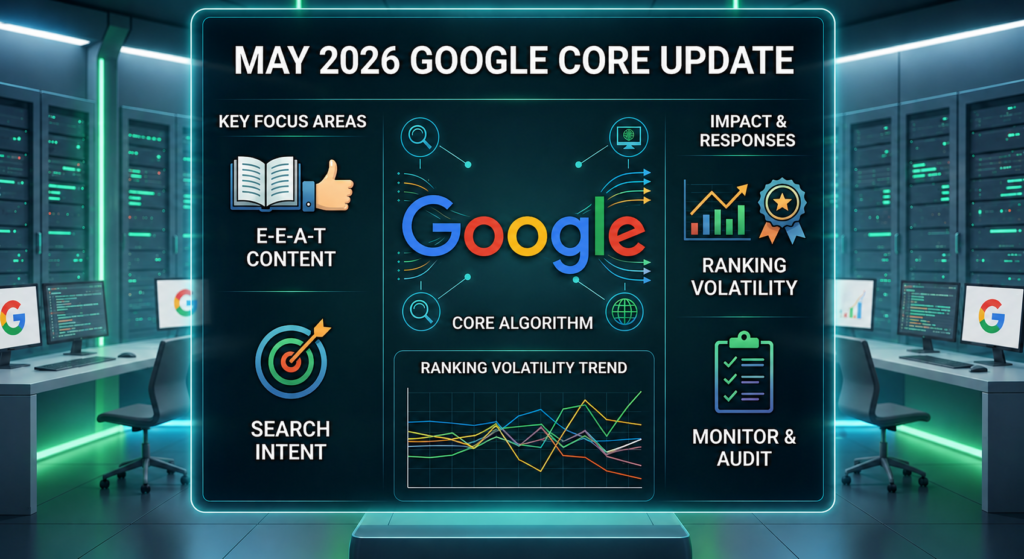
If your organic traffic started behaving strangely in the last week of May, you are not imagining it. Google confirmed the May 2026 Google Core Update on May 21, 2026, and rankings have been shifting across industries ever since. This is the second broad core update of the year, and it landed at an unusually loud moment for search.
At Quadcubes, our SEO team in Kerala has spent the rollout watching client dashboards, reading Google’s own documentation, and separating the real signal from the panic. This guide is the result. We will walk through what the Google Core Update May 2026 actually changed, who got hit, how to read your Search Console data correctly, and the recovery steps that actually work. No hype, no shortcuts, no copy-paste fixes that make things worse.
Let us get into it.
Why This Google Algorithm Update 2026 Landed at a Strange Time
Here is the context most people skip. Google began rolling out the May 2026 core update at roughly 8:40 AM PDT on May 21, just two days after the Google I/O 2026 keynote, where the company announced what it called the biggest upgrade to its Search box in over 25 years. AI Mode crossed one billion monthly users, AI Overviews reached 2.5 billion, and Google introduced background “information agents” that monitor the web for you around the clock.
So when this Google search ranking update arrived in the same news cycle, a lot of commentators rushed to connect the two. The story practically wrote itself: Google reinvents search around AI, then unleashes an algorithm update to enforce it.
The truth is calmer. Google has not stated any connection between the I/O announcements and this latest Google core update. The dashboard description is the same boilerplate it used for the March update: a regular update designed to better surface relevant, satisfying content for searchers from all types of sites. There was no companion blog post and no new guidance. As far as Google’s public framing goes, this is business as usual.
That gap between Google’s calm public messaging and its rapidly changing AI product roadmap is the real story for SEOs in 2026. We will come back to it.
What a Google Core Update Actually Is
A core update is a broad, significant change to Google’s ranking systems. Unlike a spam update or a targeted helpful content adjustment, a core update is not a penalty aimed at specific bad behaviour. It is a recalibration of how Google evaluates and ranks content across every industry, language, and content type at once.
The distinction matters because it changes how you should respond.
Core update vs spam update vs helpful content signal
- A spam update targets manipulative practices like cloaking, scaled content abuse, or link spam. If you get hit, there is usually something specific to fix.
- The helpful content signal used to be a separate periodic update, but Google folded it into the core ranking system back in March 2024. It now runs continuously, baked into how every page is assessed.
- A core update reassesses relevance and quality broadly. A ranking drop here often means a competitor’s page simply got judged as more helpful than yours, not that you did something wrong.
Google rolls out broad core updates a few times a year and announces the big ones because they cause noticeable, sitewide movement. Smaller unannounced ones happen too. The May 2026 SEO update is one of the announced, broad variety.
What Changed in the May 2026 Google Core Update
Google gave no update-specific guidance, so anyone claiming to know the exact “targets” is guessing. What we can do responsibly is read the ranking volatility, line it up with Google’s consistent direction of travel, and tell you what the patterns suggest. Here is where the Google ranking changes 2026 are clustering.
Ranking Volatility Is Hitting Whole Verticals, Not Random Pages
Early movement looks broad rather than surgical. Entire content categories are reshuffling rather than isolated URLs. This is classic core-update behaviour and it is why a single-page “fix” rarely explains what you are seeing. Compare your losses at the section or template level, not page by page.
Search Intent Alignment Is Doing More Heavy Lifting
Pages that technically mention the right keywords but answer the wrong version of the question are slipping. If someone searches a term with clear commercial intent and your page serves a thin informational answer, that mismatch is getting punished harder. Intent fit is beating keyword presence.
Content Quality Evaluation Got Sharper
The pattern that keeps repeating across recent updates: pages that restate what already ranks, without adding original value, lose ground. Google’s own self-assessment asks whether your content provides original information, reporting, research, or analysis. Pages that fail that test honestly are the ones moving down.
Authority and Trust Signals Are Being Reweighted
Sites with weak authorship, missing credentials, and no citations are more exposed, especially in money-and-life topics. This is the EEAT and Google update connection people keep raising, and it is real, even though “EEAT” is a framework Google uses to describe quality rather than a single dial it turns.
AI Content Is Not the Target, Low Value Is
This is the one to get right. Google has not said the May 2026 update targets AI-generated content. Its position remains that it judges content quality, not production method. AI-assisted writing is fine. Mass-produced, unoriginal, expertise-free output is not. The penalty, when it comes, is for low value, not for using a tool.
User Experience and Engagement Still Matter
Slow pages, intrusive layouts, and frustrating mobile experiences continue to drag results down, because they undermine the “satisfying” part of Google’s stated goal. The AI search experience raises the bar further, since Google is increasingly synthesising answers and rewarding sources it can trust.
Who Got Hit Hardest by This Latest Google Core Update
Core updates touch everyone, but some site types feel them more sharply. Based on historical core-update patterns and the early read on this one, these are the most exposed.
- Publishers and news sites, where freshness and trust are scrutinised heavily and AI Overviews compress click opportunities.
- eCommerce websites with thin product or category descriptions that read like spec sheets rather than buying help.
- Healthcare sites, a classic your-money-or-your-life category where expertise and sourcing are non-negotiable.
- Finance websites, for the same trust-critical reasons.
- Service businesses competing on local intent, where relevance and reviews decide the winner.
- Affiliate websites built on lightly rewritten reviews with no first-hand testing.
- AI-heavy content sites that scaled output faster than they scaled quality or expertise.
If you are in one of these buckets, do not assume the worst. Exposure is not the same as impact. Check your data before you change anything.
How to Tell If the Update Actually Hit You
Before you touch a single page, confirm the drop is real and tied to this update. Three signals tell the story.
Reading a Genuine Traffic Decline
Open Google Search Console and add annotations for the rollout window. Google says this update may take up to two weeks from May 21, so expect completion around early June 2026. Compare the week before the rollout started against the week after it finishes, not day-to-day noise during the rollout. Look for a sudden organic traffic decline, a drop in impressions, and clear ranking losses on pages that previously held position. If impressions are stable but clicks fell, you may be looking at SERP layout changes rather than a ranking loss.
Spotting Real Keyword Position Changes
Track your priority keywords and watch for major fluctuations, not single-position wobbles. Then manually search those terms. See who replaced you. Competitor movement tells you whether this is a quality gap, an intent gap, or simply a stronger page that improved. That manual SERP check is the single most useful diagnostic step most people skip.
Checking Search Console for Other Causes First
Rule out the boring explanations before blaming the algorithm. Check for indexing or crawl issues, manual actions, and coverage errors. Compare performance trends across Web, Image, Video, and News tabs to see where the impact concentrated. A drop that turns out to be a crawl problem needs a completely different fix than a core-update drop.
Why Your Rankings Changed
Once you have confirmed the update hit you, the next job is honest diagnosis. Ranking losses in a core update usually trace back to one of four root causes.
Content That No Longer Earns Its Spot
Thin pages, outdated information, and duplicate content are the usual suspects. If a reader still needs five more browser tabs open after finishing your article, you failed the helpfulness test. Run Google’s literal self-assessment question on your biggest losers: does this page provide original information, reporting, research, or analysis? If the honest answer is no, you have found your problem.
Pages Pointed at the Wrong Intent
A page can be well written and still lose because it answers the wrong question. Informational content ranking for transactional queries, or keyword targeting that never matched what searchers actually wanted, both get corrected during core updates. Map each losing page to the real intent behind its target query.
Technical Friction Google Cannot Ignore
Slow load times, mobile usability problems, and crawl inefficiencies do not just hurt users. They make it harder for Google to access, render, and understand your pages. Technical fixes rarely produce instant ranking jumps, but a weak technical foundation absolutely drags recovery down and leaves content misread or overlooked.
Trust Signals That Are Too Quiet
Weak authority, missing author credibility, and a lack of citations leave ranking signals on the table. If your articles have no author bios, no linked credential pages, and no sources, you are asking Google to trust you on faith during the exact moment it is reweighting trust.
How to Recover After the May 2026 Core Update
Here is the part everyone wants, and here is the uncomfortable truth Google states plainly: there are no specific recovery actions for a core update, and a ranking drop does not always mean something is broken. Recovery comes from genuine, sustained improvement, and meaningful movement often does not show until a later core update. With that framing set, this is the recovery playbook we run for Quadcubes clients.
Audit Content Quality First
Pick five pages, not fifty. Choose your biggest traffic losers that also carry real business value, and ignore the rest for now. For each, improve depth, add original insight or first-hand experience, refresh outdated facts, and answer the follow-up questions readers actually have. Treat deletion as a last resort, not a reflex. Consolidate genuinely thin pages into stronger ones rather than mass-deleting.
Reassess Search Intent Page by Page
Search your target keyword and study what is now ranking. If the winners are comparison tables and yours is a wall of text, restructure. Map every page to the dominant intent, then fix headings and structure so the page delivers that intent in the first screen, not the fifth paragraph.
Strengthen EEAT Where It Is Visible
Add real author bios with linked credentials. Build out your about and contact pages so your organisation is transparent and verifiable. Cite credible sources. For YMYL topics like health and finance, this is not optional polish, it is the price of entry. Trustworthiness is the component Google’s own documentation calls the most important.
Fix Technical SEO as the Foundation
Resolve crawl errors, fix canonicalisation and duplicate meta tags, sort out indexing issues, and shore up Core Web Vitals and mobile friendliness. None of this is a magic ranking lever, but it removes the friction that quietly caps your recovery ceiling.
Monitor Performance With Patience Built In
Track recovery in Search Console, watch your priority rankings, and set realistic expectations. You may see partial recovery between updates, but the biggest shifts tend to arrive with the next core update. Resist the urge to keep tweaking weekly. Give your changes time to be recrawled and reassessed.
SEO Best Practices for the AI Search Era
This update did not change the fundamentals, but the search landscape around it absolutely is changing. With AI Mode past a billion users and AI Overviews above 2.5 billion, optimising only for ten blue links is a shrinking strategy. Here is where to point your effort.
- Write genuinely helpful, people-first content. It is still the throughline of every core update, and it is what AI answer engines pull from too.
- Optimise for intent, not just keywords. Searches are becoming longer, conversational, and multimodal. Match the question behind the query.
- Update content consistently. Freshness and ongoing improvement beat one-time publishing, because Google evaluates patterns over time.
- Strengthen internal linking. Help Google understand topical relationships and pass authority to your important pages.
- Implement structured data. Article, FAQ, and HowTo schema help both traditional SERP features and AI systems parse and trust your content.
- Build for AEO and AIO. Answer engine optimisation and AI optimisation are, in Google’s own words, still SEO. Clear answers, strong entities, and trustworthy sourcing are what get cited in AI Overviews and AI Mode.
The bigger point: Google’s public guidance and its product roadmap are diverging. The guidance says keep making satisfying content. The roadmap says search is becoming an AI conversation. Both are true. Build for quality and entities now, and you are covered either way.
Common Mistakes to Avoid During the Rollout
Most self-inflicted damage happens in the first two weeks. Avoid these.
- Making drastic changes mid-rollout. Rankings are still moving. Wait for completion and a clean week of data before judging winners and losers.
- Deleting content too quickly. A page that dropped is not automatically a bad page. Improve before you delete.
- Over-optimising keywords. Stuffing in more keywords to “signal” quality is exactly what Google tells you not to do.
- Blindly copying competitors. Study why a competitor’s page wins, then do it better. Cloning their structure without their substance just adds another mediocre page to the web.
- Relying only on AI-written content. The tool is fine. Shipping unedited, expertise-free output at scale is the actual risk.
What SEOs Should Do Next
Strip away the noise and the May 2026 Google Core Update repeats a message Google has sent for years. Reward goes to content that is genuinely helpful, matched to real search intent, backed by visible expertise, and served on a technically sound site. Nothing here is a trick. It is the slow, compounding work of being the best answer to a question.
So do not react impulsively. Confirm the impact in Search Console, diagnose honestly using Google’s self-assessment questions, fix your highest-value pages first, and give your changes time to be reassessed. Patience during recovery is a strategy, not a weakness.
If your rankings shifted and you want a clear-eyed audit instead of guesswork, that is exactly what we do at Quadcubes. Our team digs into your content quality, search intent alignment, EEAT, and technical health, then builds a recovery roadmap tied to your business goals. Audit your site, adapt your strategy, and play the long game. That is how you come out of a core update stronger than you went in.
Frequently Asked Questions
What is the May 2026 Google Core Update?
It is Google’s second broad core algorithm update of 2026, confirmed on May 21 and rolling out over roughly two weeks. It recalibrates how Google ranks content for relevance, quality, and trust across all industries, rather than targeting any single site or practice.
Why did my website traffic drop after the update?
Most likely a competing page was judged more helpful, your content lost intent alignment, or trust signals were too weak. Always rule out crawl, indexing, and manual-action issues in Search Console first, since those mimic a core-update drop but need different fixes.
How long does recovery take after a core update?
Often longer than people expect. Google says there is no quick fix, and the biggest recovery usually appears with a later core update once your improvements have been recrawled and reassessed. Plan in months of consistent improvement, not days.
Does AI content get penalised in this update?
No. Google has not said this update targets AI content, and its stated position is that it judges quality, not production method. AI-assisted writing is acceptable. Low-value, unoriginal, expertise-free content is the real liability, however it was made.
What should I fix first after a ranking drop?
Confirm the drop is tied to the update, then pick your five highest-value losing pages. Improve their depth, originality, and intent fit before anything else. Skip mass edits and resist deleting pages until you have tried to genuinely improve them.
Are technical SEO issues part of ranking drops?
They can be. Slow speed, mobile problems, and crawl inefficiencies make pages harder for Google to evaluate and can cap your recovery. Technical fixes rarely deliver instant jumps, but a clean foundation is essential for content improvements to take effect.