
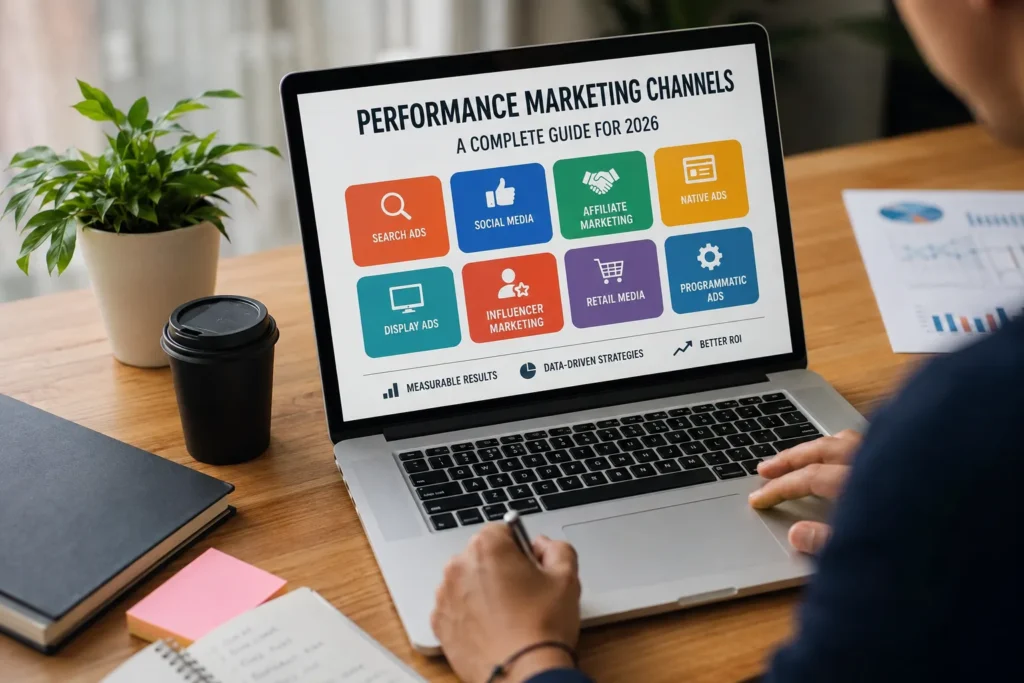
Introduction to Performance Marketing Channels
Marketing today is no longer about guesswork. Every rupee you spend should bring a measurable result. That is why performance marketing channels are now the backbone of modern business growth.
Instead of focusing solely on visibility, brands track real outcomes like clicks, leads, and sales. This approach improves marketing channel performance and ensures better decision-making. It also helps businesses scale faster with less waste.
From startups in Kochi to growing brands across India, companies now rely on performance-based marketing to stay competitive. With the right mix of channels, data, and strategy, growth becomes predictable and sustainable.
Want to choose the right performance marketing channels for your business? Get expert guidance from Quadcubes.
What Are Performance Marketing Channels?
Performance marketing channels are platforms where advertisers pay only for measurable results.
These results include:
- Clicks (CTR – Click-Through Rate)
- Conversions (Conversion Rate)
- Leads or sales (CPA – Cost Per Acquisition)
Unlike traditional marketing, these performance media channels are fully data-driven. Every campaign is tracked using KPI tracking and attribution modelling.
Example:
If you run ads on Google and only pay when someone clicks, that is performance-based advertising.
Performance Marketing Channels List
Here is a simple and practical performance marketing channels list used in 2026:
1. Search Engine Marketing (SEM)
- Platforms: Google Ads
- Best for: High-intent users
- Metric: Conversion Rate
2. Paid Social
- Platforms: Meta, TikTok, LinkedIn
- Best for: Audience targeting
- Metric: CTR + Engagement
3. Affiliate Networks
- Pay partners for sales
- Best for: Low-risk scaling
- Metric: CPA
4. Native Ads
- Blends with content
- Best for: Awareness + clicks
- Metric: Engagement rate
5. Display Media
- Banner ads across websites
- Best for: Retargeting campaigns
- Metric: Impressions + CTR
6. Influencer Marketing
- Creator-led promotions
- Best for: Trust + conversions
- Metric: Influencer ROI
7. Retail Media Networks
- Platforms: Amazon Ads
- Best for: E-commerce
- Metric: ROAS
8. Programmatic Advertising
- Automated ad buying
- Uses real-time bidding
- Best for: Scale + precision
Confused about where to invest your marketing budget? Let Quadcubes create a data-driven plan for you.
Types of Performance Marketing Explained
Pay-Per-Click (PPC)
You pay for each click.
Example: Google Search Ads.
PPC is one of the fastest ways to bring targeted traffic to your website. It helps businesses appear in front of users actively searching for products or services, making it highly effective for quick visibility and conversions.
Cost-Per-Acquisition (CPA)
You pay only when a sale happens.
Best for: ROI-focused results.
CPA campaigns focus heavily on profitability because businesses spend money only when a customer completes a desired action. This model is commonly used by e-commerce brands that want better control over customer acquisition costs.
Cost-Per-Lead (CPL)
You pay for each lead generated.
Best for: Lead generation campaigns.
CPL works well for businesses that rely on inquiries, sign-ups, or consultation bookings. It is widely used in industries like education, healthcare, real estate, and B2B services.
Affiliate Marketing
Partners promote your product and earn a commission.
Best for: Scalable growth with low upfront cost.
Affiliate marketing allows brands to expand their reach through creators, bloggers, and publishers. Since payment happens only after successful conversions, it becomes a low-risk and performance-focused marketing model.
Performance Marketing vs Digital Marketing
| Feature | Performance Marketing | Digital Marketing |
| Focus | Measurable results | Awareness + engagement |
| Payment | Based on results | Fixed budgets |
| Strategy | Data-driven | Mix of strategies |
| KPI Tracking | Core focus | Optional |
Simple takeaway:
Performance marketing is a subset of digital marketing focused on ROI.
Multi-Channel & Cross-Channel Performance Marketing
Running ads on one platform is not enough anymore.
Multi-channel performance marketing means using multiple platforms.
Cross-channel performance means making them work together.
Example Flow:
- User sees Instagram ad
- Clicks website
- Gets retargeted on Google
- Converts after email follow-up
This approach uses:
- Audience segmentation
- Retargeting campaigns
- First-party data
- AI-driven automation
Result: Better customer journey and higher conversions.
Performance-Based Marketing Strategy
Here is a simple step-by-step framework:
- Define KPIs: ROAS, CPA, CTR
- Choose Channels: Based on audience and goals
- Set Budget: Focus on marketing spend efficiency
- Launch Campaigns: Use strong creatives
- Optimise: A/B testing, Algorithmic bidding, Funnel optimisation
Maximise ROI with campaigns tailored to your business goals. Talk to Quadcubes today.
Key KPIs in Performance Marketing
What are the 5 key performance indicators in marketing?
- ROAS (Return on Ad Spend): Revenue ÷ Ad Spend
- CPA (Cost Per Acquisition): Cost per customer
- CAC (Customer Acquisition Cost): Total marketing cost ÷ customers
- CLV (Customer Lifetime Value): Total value of a customer
- CTR (Click-Through Rate): Clicks ÷ impressions
These metrics help improve marketing channel performance.
SEO vs PPC: Which is Better?
Short answer: It depends.
Both SEO and PPC are powerful marketing strategies, but they serve different goals. The right choice depends on your business stage, budget, competition, and growth timeline.
SEO
- Long-term growth
- Free organic traffic
- Builds brand authority
- Slow but sustainable results
SEO helps your website rank naturally on search engines over time. It is ideal for businesses that want steady traffic, better credibility, and lower customer acquisition costs in the long run.
PPC
- Instant traffic
- Paid advertising
- Quick testing and optimisation
- Faster lead generation
PPC campaigns are useful when businesses need immediate visibility or want to promote time-sensitive offers. They also help test keywords, audiences, and landing pages quickly before scaling.
Best Strategy: Use Both
A balanced approach often delivers the best results. SEO builds long-term visibility, while PPC drives faster conversions and short-term traffic.
- Startups → PPC for quick visibility and lead generation
- Growing brands → SEO + PPC for balanced growth
- Established brands → Full funnel strategy combining organic and paid channels for maximum reach and ROI
Businesses looking to scale efficiently should understand the full range of customer acquisition channels for modern marketers available today.
Role of Performance Marketing Agencies
A performance-based marketing agency helps you:
- Manage media buying
- Track ROI
- Optimise campaigns
- Scale faster
Working with experts saves time and reduces costly mistakes.
At Quadcubes, businesses get a complete solution for performance marketing, SEO, social media, and branding under one roof. This makes it easier to manage campaigns and achieve consistent growth.
Still unsure which channel works best? Talk to a performance marketing expert today.
Future Trends in Performance Marketing
Here is what is shaping 2026:
- AI-driven automation for campaign management
- Privacy-first marketing with first-party data
- Zero-party data from direct user input
- Machine learning models for predictive analytics
The focus is shifting towards smarter, more personalised campaigns.
FAQs
1. What are the channels of performance marketing?
Performance marketing channels include search ads, social media ads, affiliate marketing, native ads, display ads, and influencer campaigns. These channels focus on measurable results like clicks and conversions.
2. What are the types of performance marketing?
The main types are PPC, CPA, CPL, and affiliate marketing. Each type is based on a specific outcome like clicks, leads, or sales.
3. What are the 4 types of marketing channels?
The four main types are paid, owned, earned, and shared media. Performance marketing mainly focuses on paid channels.
4. What are performance media channels?
These are digital platforms where advertisers pay only for results. Examples include Google Ads, Meta Ads, and affiliate networks.
5. What are the 5 key performance indicators in marketing?
ROAS, CPA, CAC, CLV, and CTR are the most important KPIs used to measure success.
6. What is omnichannel performance marketing?
It means creating a seamless experience across all platforms like social media, search, and email, ensuring consistent messaging and better conversions.
7. Which one is better, SEO or PPC?
Both have benefits. SEO is better for long-term growth, while PPC gives quick results. A combined strategy works best.
Conclusion
Performance marketing is no longer optional. It is the foundation of modern digital growth. Businesses that focus on measurable outcomes will always stay ahead.
Choosing the right performance marketing channels can improve ROI, reduce costs, and create predictable growth. But success depends on strategy, execution, and continuous optimisation.
If you want a partner who understands both creativity and data, Quadcubes can help you build scalable campaigns that deliver real results.